
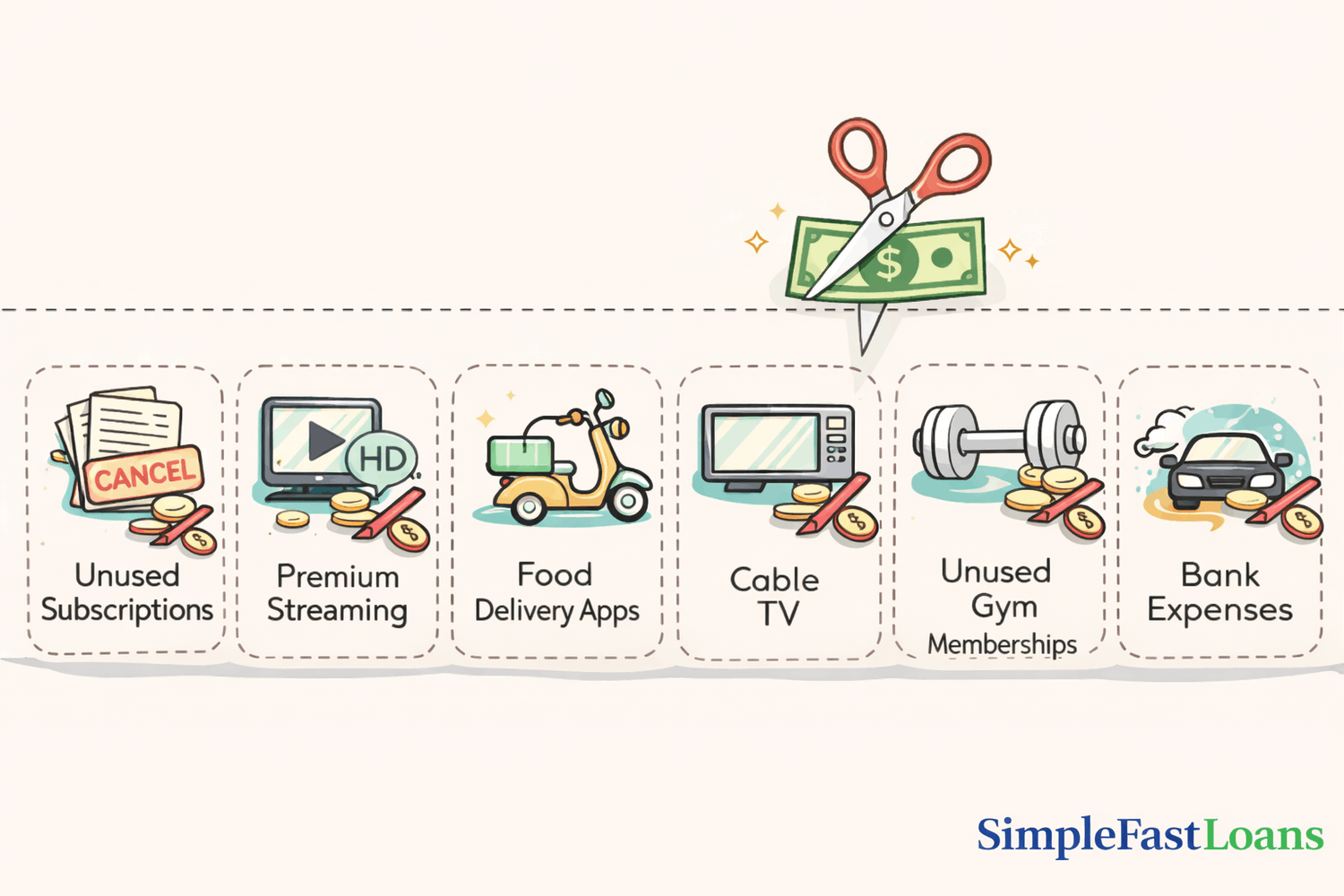
Need to Save Money Fast? Start by Cutting These 17 Budget Items
Written by: Jacob S.
Published on:
Updated on:


We've all been there. The bill arrives that you weren't expecting. Your income takes a hit. Or maybe you're staring at your bank account, realizing that the emergency fund you keep promising yourself isn't going to build itself. Whatever brought you here, you're not alone — and more importantly, you don't need to overhaul your entire life to start saving money right now.
Here's the truth: Saving money fast doesn't require extreme frugality, giving up everything you enjoy, or making dramatic permanent sacrifices. What it actually requires is identifying the right leaks in your budget — the ones that drain the most money while providing the least value — and plugging them first.
The strategy is simple: analyze your monthly budget, cut high-impact, low-value expenses first. Focus on recurring monthly charges, because they compound silently. And make reversible cuts before permanent lifestyle changes — that way, nothing feels final.
How We Identified the Best Expenses to Cut First
This guide is based on a combination of real-world budgeting behavior, financial expert recommendations, and common spending patterns observed across U.S. households. Financial planners consistently recommend starting with high-impact, low-value recurring expenses because they deliver the fastest results without requiring major lifestyle changes.
We prioritized expenses that meet three criteria:
- Recurring (monthly or frequent)
- Easy to reduce or eliminate quickly
- Low long-term impact on quality of life
This approach helps you free up cash flow immediately, often within the first billing cycle, while avoiding cuts that could hurt your financial stability long term.
Key Takeaways
- You don't need a financial overhaul; you need strategic cuts. Targeting high-cost, low-value recurring expenses delivers faster results than dramatic lifestyle changes. Small monthly savings compound into thousands of dollars per year.
- Recurring charges are the biggest silent budget killers. Subscriptions, streaming stacks, food delivery fees, and unused memberships drain money automatically every month, and most people significantly underestimate how much they're losing to them.
- Cutting just 5 of these 17 items can free up $200 to $500 per month. That's $2,400 to $6,000 per year, enough to build an emergency fund, pay down debt, or hit a savings goal that currently feels out of reach.
- Know what not to cut. Slashing retirement contributions, essential insurance, or minimum debt payments to save money fast can cause serious long-term financial damage that far outweighs any short-term relief.
Quick Answer: What to Cut First
If you need to save money fast, start by cutting or reducing:
- Unused subscriptions
- Premium streaming services
- Food delivery apps
- Dining out
- Impulse online purchases
- Premium cell phone plans
- Cable TV
- Gym memberships you don't use
- Brand-name groceries
- High insurance premiums
- Convenience store spending
- Alcohol and daily coffee runs
- Buy-now-pay-later purchases
- Excessive utility usage
- App store and in-game purchases
- Bank fees
- Unnecessary car expenses
Below, we break down exactly how to cut each one — and how much you could realistically save.
What You Should Never Cut to Save Money
Not all expenses are safe to eliminate. Cutting the wrong things can create long-term financial damage that outweighs short-term savings.
Before reducing your budget, protect these essentials:
- Minimum debt payments (to avoid penalties and credit damage)
- Health, auto, and renters/home insurance
- Retirement contributions (especially if you receive an employer match)
Skipping these can lead to fees, higher interest costs, or financial risk that ultimately makes your situation worse—not better.
The 17 Budget Items to Cut First
Each of the 17 items below has a summary of the reasoning behind why it is OK to cut it, and the potential money you are likely to save. Let's get into it.
1. Unused Subscriptions
Recurring micro-charges are one of the sneakiest budget drains around. A $9.99 app here, a $14.99 meal kit there, a software trial you forgot to cancel — they add up fast. Most people have anywhere from 5 to 15 active subscriptions at any given time, and research consistently shows we underestimate how much we're spending on them.
To tackle this: audit your bank and credit card statements for the past 90 days and flag every recurring charge, no matter how small. Use a subscription tracking app like Rocket Money or Trim to catch anything you've missed. Then cancel immediately — don't "pause." Pausing just delays the charge.
Potential savings: $50–$200/month.
2. Premium Streaming Services
Netflix. Hulu. Disney+. Max. Peacock. Apple TV+. The average household now pays for 4–5 streaming services, often spending $60–$100 per month. The stacking effect is real, and chances are you're not using all of them equally.
The fix: rotate subscriptions monthly. Watch everything you want on Netflix this month, cancel, then switch to Hulu next month. Share legally within household plans — many services allow multiple screens. And use free tiers temporarily; Tubi, Pluto TV, and Peacock's free tier are surprisingly good.
Potential savings: $20–$60/month.
3. Food Delivery Apps
Food delivery apps are one of the most expensive conveniences in modern life. That $14 lunch from DoorDash isn't really $14 — it's $14 plus a $4.99 delivery fee, a $2.99 service fee, and a 20% tip. You're often paying 40–60% more than the menu price.
Switch to pickup instead — you still get the convenience of ordering ahead without the fees. Batch cook on Sundays so you have ready-made meals in the fridge on the nights you'd normally order out. And stock a few emergency freezer meals for the moments when willpower runs low.
Potential savings: $80–$200/month.
4. Dining Out
"It's just $20 here and there" is one of the most expensive sentences in personal finance. A $20 dinner twice a week is $160/month — $1,920 per year. Add in lunches, weekend brunches, and work coffee runs, and you could easily be spending $400–$600 monthly on eating out without fully realizing it.
Start by calculating your actual weekly restaurant spending — write it down. Seeing the real number is often motivation enough. Then set a dining cap: one restaurant meal per week maximum, while you're in savings mode. Consider hosting friends instead of meeting at restaurants — you'll spend a fraction of the cost and likely have a better time.
Potential savings: $100–$400/month.
5. Impulse Online Purchases
One-click buying, retargeted ads, and social media shopping features are engineered to bypass your better judgment. Retailers have spent billions making the path from "I kind of want this" to "it's already in my cart" as frictionless as possible.
Add friction back. Implement a 48-hour rule: put anything non-essential in your cart and wait two days before buying — most urges simply pass. Remove saved payment methods so you have to enter your card number manually. Unsubscribe from retail emails entirely. If you're not seeing the deals, you're not tempted.
Potential savings: $50–$150/month.
6. Premium Cell Phone Plans
The big carriers charge a premium for brand recognition as much as for service. Many people pay $80–$120/month per line when they could get equivalent coverage for $25–$45 through Mobile Virtual Network Operators (MVNOs) that run on the exact same towers.
First, check your actual monthly data usage — most people use far less than their "unlimited" plan provides. Then explore MVNOs like Mint Mobile, Visible, or Consumer Cellular. If you're not ready to switch, call your carrier's retention department and ask for loyalty discounts. They often have unadvertised promotions for customers who ask.
Potential savings: $30–$80/month per line.
7. Cable TV
Cable packages routinely run $100–$200/month once you factor in equipment rental fees, regional sports surcharges, and the post-promotional-period price hike. Meanwhile, streaming and free over-the-air TV has never been better.
A digital antenna ($25–$50 one-time cost) gets you local channels in HD for free. YouTube TV, Hulu + Live TV, or Sling offer live TV packages for $40–$75/month. And watch for promotional pricing traps — when your intro rate expires, call and negotiate or be ready to cancel.
Potential savings: $60–$150/month.
8. Gym Memberships You Don't Use
The gym membership you're paying for but not using is pure guilt spending. There's no financial benefit to keeping it — only the illusion that you might eventually go. If you're not using it consistently right now, it's time to be honest.
YouTube has thousands of free workout channels covering everything from HIIT to yoga to strength training. Walking and running cost nothing and are among the most effective forms of exercise available. And if you genuinely want a facility, community recreation centers and YMCA branches often charge $20–$40/month — a fraction of a premium gym.
Potential savings: $20–$80/month.
9. Brand-Name Groceries
Store-brand and private-label products have dramatically improved in quality over the past decade. In many cases, they're made in the same facilities as name brands with a different label. Yet name-brand items typically cost 20–30% more.
Start saving money on groceries beginning with pantry staples: flour, sugar, rice, pasta, canned goods, spices. You likely won't notice any difference. Store-brand dairy, bread, and frozen vegetables are also typically comparable. The goal isn't blanket substitution — keep the name brands you genuinely prefer. It's about smart swapping where it doesn't matter.
Potential savings: $30–$100/month.
10. High Insurance Premiums
Insurance premiums are one of the most ignored monthly budget expense. Many people set them up and never revisit them — even as rates change, life circumstances shift, and competitive options emerge. Loyalty doesn't pay in insurance.
Get at least three competing quotes for auto insurance — rates vary enormously between providers for identical coverage. Consider raising your deductible if you have an emergency fund to absorb the difference. And bundle home and auto policies with the same provider to unlock multi-policy discounts. Make this an annual review habit.
Potential savings: $50–$200/month.
11. Convenience Store Spending
Gas stations and convenience stores charge a significant markup on drinks, snacks, and other everyday items. That $3.49 energy drink is $1.99 at a grocery store. The "quick stop" habit is one of the easiest to break once you actually see how quickly it adds up.
Prep a weekly snack bag and keep it in your car or bag to eliminate the hungry-on-the-road stop. Buy beverages in bulk at warehouse clubs or grocery stores instead of individually to save money for lunch while at work. And try to plan your gas stops separately so they don't turn into impulse shopping trips.
Potential savings: $20–$60/month.
12. Alcohol and Daily Coffee Runs
This isn't about moralizing, it's about math. A $6 specialty coffee, five days a week, is $120/month or $1,440/year. Regular bar outings add up even faster. The goal isn't elimination; it's awareness and intentional reduction.
Invest in a quality home coffee setup. A decent espresso machine pays for itself in about a month. Limit bar spending to weekends, or set a fixed monthly "fun money" budget for it. Keep your coffee treat if you love it, but make it intentional: one or two a week as something you enjoy, rather than a daily default you don't even think about.
Potential savings: $50–$250/month.
13. Buy-Now-Pay-Later Purchases
BNPL services like Affirm, Klarna, and Afterpay feel painless in the moment — four easy payments of $25 sounds much better than $100 upfront. But when you have multiple BNPL arrangements running simultaneously, your budget gets quietly squeezed from multiple directions.
Overlapping installments create a "payment stack" that makes your monthly cash flow feel tight without an obvious cause. Late fees on missed payments add up quickly and are easy to overlook. And the psychological effect is real: spreading payments makes you more likely to buy things you wouldn't normally afford. The action here is simple — pause all new BNPL purchases until your existing ones are paid off.
Potential savings: Variable, but meaningful in reduced fees and overspending.
14. Excessive Utility Usage
Utility bills are an area where small behavioral adjustments deliver fast, measurable results. You don't need to freeze in the dark; just a few targeted changes can trim $20–$60 off your monthly bills without any real sacrifice.
Adjust your thermostat by 2–3 degrees; each degree can save 1–3% on your heating and cooling bill. Seal air leaks around doors and windows with inexpensive weatherstripping. Wash clothes in cold water, which works just as well for most laundry. And unplug vampire electronics, TVs, game consoles, and phone chargers, which draw power even when they're not actively in use.
Related: Best temperature to set thermostat to save money
Potential savings: $20–$60/month.
15. App Store and In-Game Purchases
A $2.99 app here, a $4.99 in-game currency pack there. These feel trivial in the moment but are designed to be frequent and habitual. Apple and Google make them intentionally frictionless, and many games are built around psychological reward loops that encourage repeat spending.
Go to Settings in your Apple or Google account and review your complete purchase history. The total is often surprising. Disable in-app purchases or require a password for every transaction. And consider deleting games that rely on microtransactions; there are plenty of quality free games that don't use that model.
Potential savings: $15–$50/month.
16. Bank Fees
Bank fees are entirely avoidable with the right account setup — yet millions of people pay $5–$35/month in maintenance fees, overdraft charges, and out-of-network ATM fees. That's essentially paying your bank for the privilege of storing your money.
Switch to a no-fee checking account. Online banks like Ally, Chime, and SoFi charge $0 monthly maintenance fees and often reimburse ATM fees. Set up low-balance alerts to prevent overdrafts before they happen. And only use in-network ATMs.
Potential savings: $10–$50/month.
17. Unnecessary Car Expenses
Cars are expensive, but many people are paying more than they need to. From high-interest auto loans to dealership add-ons that quietly pad your monthly payment, real savings are often hiding in your car expenses.
Refinance your auto loan if rates have dropped or your credit score has improved since you bought — even 1–2% less in interest makes a meaningful difference over the life of a loan. Drop unnecessary dealer add-ons like redundant extended warranties or GAP insurance you're paying for twice. Cut back on professional detailing in the short term. And explore carpooling temporarily if you have a long commute.
Potential savings: $30–$150/month.
How Much Could You Actually Save?
Here's what a conservative approach to cutting just a handful of these items looks like in practice:
- Cancel 3 unused subscriptions + switch to a cheaper phone plan: ~$100/month saved
- Cut food delivery and reduce dining out by half: ~$150/month saved
- Switch to store-brand groceries + reduce coffee runs: ~$80/month saved
That's $330/month — or nearly $4,000 per year — from just five changes.
An emergency fund of $1,000 becomes reachable in about 3 months. A $5,000 vacation fund becomes realistic within 15 months. These aren't hypotheticals — they're what happens when recurring leaks get plugged.
What to Cut First: A Priority Framework
Not sure where to start? Run any expense through this three-question filter:
- Is it recurring? Ongoing monthly charges deliver compounding savings when cut.
- Does it provide essential value? Be honest — "nice to have" is different from "need."
- Can I replace it cheaply or temporarily? Temporary cuts are sustainable cuts.
In general, prioritize the expenses with the highest monthly cost and lowest lifestyle impact. Those are your fastest wins.
Most people who feel financially squeezed aren't spending too much on big things — they're losing money in dozens of small, recurring, forgettable places. The secret is finding those leaks and plugging the right ones first.
You don't have to cut everything on this list. Cutting five items strategically can free up $200–$500 a month — money that can build your emergency fund, pay down debt, or simply give you breathing room you didn't have before.
Methodology: This article incorporates insights from financial planners, consumer spending research, and budgeting studies to ensure accuracy and practical relevance. Key topics include subscription spending behavior, household budgeting trends, and cost-reduction strategies.
