
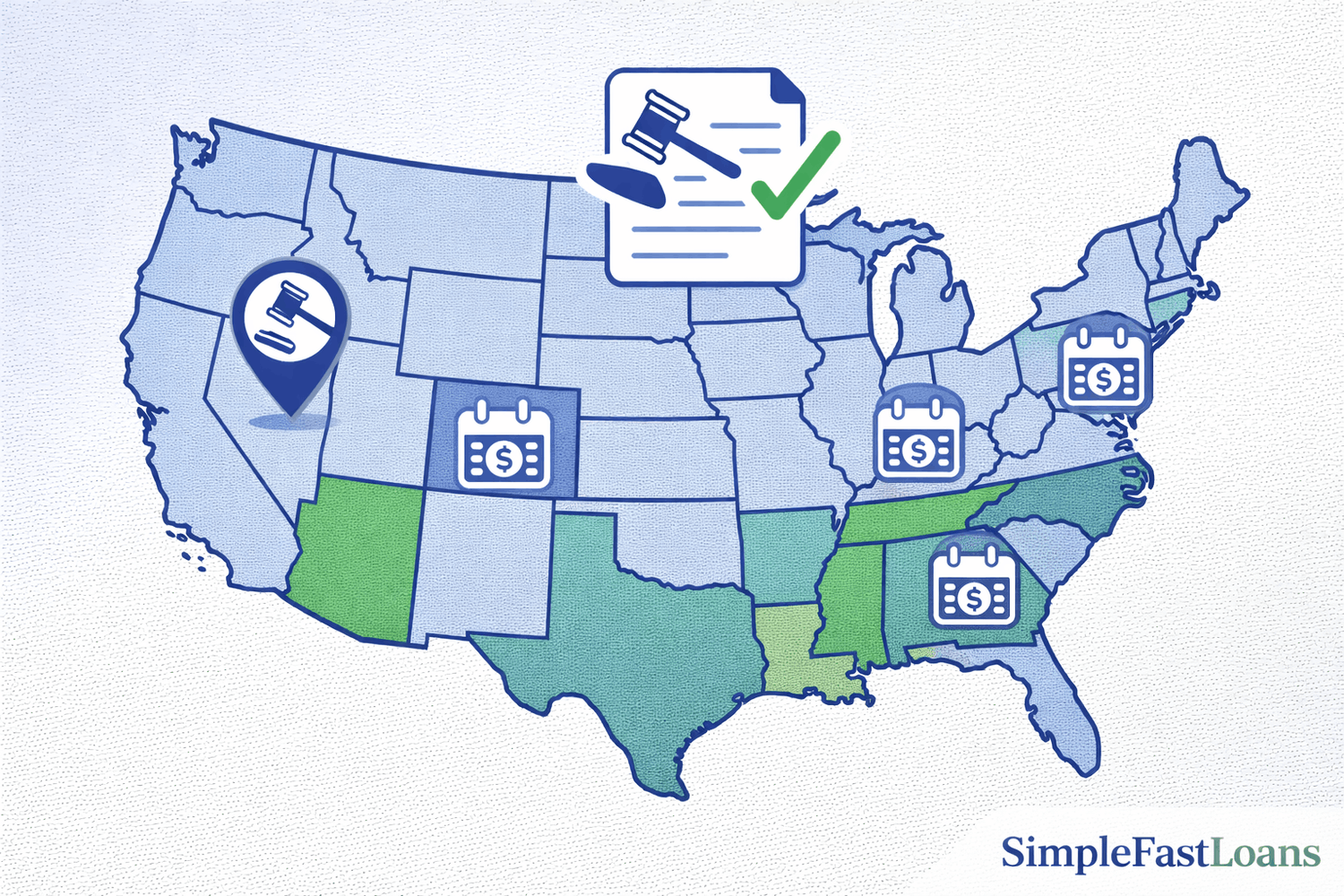
Installment Loan Laws by State
Written by: Jacob S.
Published on:
Updated on:


Installment loans are closed-end loans. A borrower receives a fixed lump sum and repays it through a set number of scheduled payments over time. Unlike credit cards or lines of credit, the repayment structure is defined upfront. However, installment loan laws and interest-rate limits can vary significantly from state to state.
In the United States, consumer lending laws are largely set at the state level. That means the interest rate a borrower can be charged, the fees a lender can collect, the licenses a lender must hold, and the protections a borrower can count on all vary depending on where they live. Some states impose strict rate caps. Others use tiered pricing systems. A few maintain broad usury limits while allowing licensed lenders to operate under separate statutes.
Federal law still applies nationwide, disclosure requirements under the Truth in Lending Act, protections for military service members under the Military Lending Act, and oversight from the Consumer Financial Protection Bureau all set a baseline floor. But above that floor, the rules vary significantly from state to state.
Disclaimer: This guide was researched and updated in March 2026 to reflect current installment loan laws across all 50 states. Because lending regulations change frequently and vary by state, this article is for informational purposes only and should not be considered legal or financial advice. Installment loans are regulated primarily at the state level, meaning interest rate caps, fees, and borrower protections can differ significantly depending on where you live. Understanding your state’s rules can help you avoid high-cost loans and make safer borrowing decisions.
Key Takeaways
- Installment loan regulations are primarily set at the state level, meaning interest rate caps, lender licensing requirements, and borrower protections vary significantly depending on where a borrower lives.
- Most states regulate installment lending through a few consistent tools. Rate caps, lender licensing requirements, fee restrictions, and loan term rules form the foundation of most state frameworks, even where the specific details differ.
- Several states have adopted a 36% APR cap through legislation or voter initiative, including Illinois, South Dakota, and Montana, while others use tiered pricing structures that allow higher rates on smaller loan amounts.
- Federal law sets a nationwide baseline. The Truth in Lending Act requires standardized disclosures on all consumer loans, and the Military Lending Act caps rates at 36% Military APR for active-duty service members, regardless of state law.
- Borrowers can protect themselves by verifying lender licensing, comparing offers using APR rather than monthly payments, and calculating total repayment cost before signing any loan agreement.
How Installment Loans Are Regulated by State and Federal Law
Here are the notable differences between state installment loan regulations and the federal regulation of installment loan products:
State vs. Federal Installment Loan Regulation
Consumer lending in the U.S. operates under a dual regulatory structure. States hold primary authority over most lending rules, while federal law establishes certain baseline protections that apply everywhere.
States typically control:
- Interest rate caps (usury laws)
- Lender licensing and registration requirements
- Maximum and minimum loan amounts
- Fee restrictions (origination fees, late fees, returned payment fees)
- Repayment term requirements
- Refinancing and rollover rules
Federal law primarily governs:
- Loan disclosure requirements
- Specific borrower protections
- Lending to active-duty military service members
- Oversight of certain financial institutions
Key federal laws affecting installment loans:
The Truth in Lending Act (TILA) requires lenders to disclose the APR, total finance charge, amount financed, and payment schedule on all consumer loans — giving borrowers a standardized basis for comparison regardless of which state they're in.
The Military Lending Act caps the Military APR at 36% for covered credit products extended to active-duty service members and their dependents, regardless of state law.
The Dodd-Frank Act established the Consumer Financial Protection Bureau (CFPB), which holds supervisory and enforcement authority over many consumer financial products, including installment loans from nonbank lenders.
State Regulations for Installment Loans
Despite wide variation in the specifics, most states regulate installment lending through a few consistent mechanisms.
Interest Rate Caps (Usury Laws)
Most states impose limits on the interest rates lenders may charge for consumer loans. These caps — known as usury laws — are among the most consequential pieces of lending regulation, directly affecting the cost of borrowing and the types of products available in a given state.
A few important nuances:
- Caps often vary based on loan amount. States frequently allow higher rates on smaller loans, based on the argument that smaller loans carry higher per-dollar servicing costs.
- Many states use tiered rate structures, where the maximum allowable rate decreases as the loan amount increases.
- A common tiered example: a higher cap on the first $1,000, a lower cap on the next portion, and the lowest cap on amounts above a certain threshold.
These tiered systems are common in states that regulate small installment loans through consumer finance statutes rather than a single blanket cap.
Lender Licensing Requirements
Most states require nonbank lenders offering installment loans to obtain a consumer finance license or equivalent authorization before doing business in that state. Licensing requirements vary but commonly include background checks on principals, proof of financial stability, ongoing regulatory reporting, and periodic examinations by state regulators.
State banking departments or financial regulation agencies typically oversee licensed consumer lenders. Borrowers can usually verify whether a lender holds a valid license through their state regulator's website, and doing so is one of the most effective ways to avoid unlicensed or predatory operators.
Fee Restrictions
In addition to interest rate caps, states frequently regulate the fees lenders may charge. Commonly regulated fees include origination fees, administrative fees, late-payment fees, and returned-payment fees. Some states require origination fees to be included in the APR calculation, which ensures they're visible in cost comparisons. Others allow certain fees to be charged outside the rate cap, which can meaningfully increase the total cost of a loan if not examined carefully.
Loan Term Requirements
Certain states impose minimum or maximum loan terms to prevent installment loans from functioning as de facto short-term balloon-payment products. Rules may include minimum repayment periods for small-dollar loans, maximum loan lengths, or requirements that loans be repaid in true installments rather than a single lump sum. These provisions aim to ensure that installment loans provide genuine repayment breathing room rather than becoming a cycle of debt.
Why Installment Loan Laws Vary by State
Unlike some financial products that are governed primarily by federal law, installment loans are regulated at the state level. This means each state sets its own rules regarding:
- Maximum interest rates (APR caps)
- Loan amounts and term limits
- Licensing requirements for lenders
- Fee structures and borrower protections
Some states enforce strict interest rate caps—often around 36% APR—while others allow significantly higher rates or rely on broader “unconscionable lending” standards. Because of these differences, the cost and risk of borrowing can vary widely by location.
Installment Loan Laws by State
Here are installment loan laws by state at a glance:
| State | Regulation Type | APR Cap / Rate Limit | Lender Licensing Required | Notable Consumer Protections |
|---|---|---|---|---|
| Illinois | Flat cap | 36% APR (most lenders) | Yes | Predatory Loan Prevention Act; broad cap across multiple loan types |
| South Dakota | Flat cap | 36% APR | Yes | Voter-approved cap; significantly reduced high-cost short-term lending |
| Montana | Flat cap | 36% APR | Yes | Voter-approved cap; applies to payday and small-loan products |
| California | Tiered | Varies by loan amount; special rules for $2,500–$10,000 | Yes | Credit bureau reporting required; pilot program for responsible small-dollar lending |
| Ohio | Tiered | Rate and fee limits by loan size | Yes | Structured reform framework; fee and rate transparency requirements |
| Texas | Tiered / CSO model | Varies by lender structure and license type | Yes | CSO licensing system; disclosure requirements apply |
| Louisiana | Tiered | Varies by loan size under Consumer Credit Law | Yes | Tiered rate structure; disclosure and reporting standards |
| New York | Low general usury limit | Civil usury cap among the lowest in the U.S. | Yes | Active enforcement against unlicensed lenders; rent-a-bank protections |
| Arkansas | Low general usury limit | Constitutional usury cap | Yes | Constitutional rate limits; limited high-cost nonbank lending |
| Connecticut | Low general usury limit | General usury limit applies | Yes | Active state banking oversight; rate and fee restrictions |
| Missouri | Licensing-based | Varies; structural loan requirements apply | Yes | Minimum loan amounts and installment schedule mandates |
| Colorado | Uniform Consumer Credit Code (UCCC) | Maximum charges governed by UCCC | Yes | Comprehensive UCCC framework; ongoing small-dollar lending updates |
Consumer Protections in State Installment Loan Laws
Even where the specific rules differ, several borrower protections appear repeatedly in state lending frameworks.
Mandatory Loan Disclosures
Under TILA — which applies federally — lenders must disclose the APR, total loan cost, payment schedule, and total of payments before the borrower signs. This baseline disclosure requirement ensures borrowers have the information needed to compare offers, regardless of state.
Limits on Loan Refinancing or Rollovers
Some states restrict how often lenders can refinance or renew installment loans. Repeated refinancing — sometimes called "loan flipping" — can trap borrowers in a cycle where they pay significant fees and interest without meaningfully reducing the principal balance. State rules limiting this practice are a meaningful consumer protection, particularly for borrowers in financial distress.
Reporting Requirements
Some states require lenders to report payment activity to credit bureaus or centralized regulatory databases. These systems serve a dual purpose: they can help borrowers build credit history through on-time payments, and they allow regulators to track loan stacking — situations where a borrower takes out multiple loans simultaneously from different lenders.
States With Broad Interest Rate Caps
Several states have enacted relatively strict, broad-based caps on consumer loan interest rates, limiting what most lenders can charge regardless of loan type or size.
Illinois
Illinois enacted the Predatory Loan Prevention Act, which limits consumer loan rates to 36% APR for most lenders. The cap applies broadly across several types of consumer loans and was specifically designed to curtail high-cost lending products that had been prevalent in the state. The law represents one of the more sweeping state-level rate cap efforts in recent years.
South Dakota
South Dakota voters approved a ballot initiative establishing a 36% APR cap on payday loans and certain small consumer loans. The measure significantly reduced the availability of very high-cost short-term lending products that had previously operated in the state, and it marked a notable shift, given that South Dakota had historically been known for permissive lending laws.
Montana
Montana similarly adopted a 36% APR cap through a voter initiative, limiting payday loan rates and other small-loan products. Like South Dakota, the cap was driven by direct voter action rather than legislative movement, reflecting broad public concern about high-cost lending in the state.
States With Tiered Loan Rate Structures
Several states regulate installment loans using tiered interest-rate formulas rather than a single uniform cap. Under this approach, lenders may charge a higher rate on the first portion of a loan, with the allowable rate declining for larger loan amounts. The result is a sliding scale designed to balance consumer protection with the economic realities of small-dollar lending.
California
California's lending framework includes tiered interest-rate limits for consumer installment loans, along with special rules governing loans between $2,500 and $10,000. The state also operates a pilot program encouraging responsible small-dollar installment lending as an alternative to higher-cost products. California additionally requires certain lenders to report borrower payment performance to credit bureaus. A provision intended to help borrowers build credit through responsible repayment.
Ohio
Ohio has undergone significant lending law reform in recent years, moving toward a more structured framework for small-dollar consumer loans. The state's regulations include rate and fee limits designed to make installment loan costs more predictable and transparent for borrowers, while still allowing nonbank lenders to operate under a licensing system.
Texas
Texas uses a Credit Services Organization (CSO) model alongside its consumer lending statutes, creating a somewhat complex regulatory environment for installment lenders. Rates and fees vary depending on the structure of the loan and the lender's licensing category. Borrowers in Texas benefit from shopping carefully, as cost differences between lenders can be significant.
Louisiana
Louisiana regulates consumer installment loans through a tiered rate structure under its Consumer Credit Law. Allowable rates vary based on loan size, and licensed lenders are required to meet disclosure and reporting standards. The state has historically maintained a licensing-based framework for consumer finance companies offering personal installment loans.
States With Lower Usury Limits for Consumer Loans
Some states maintain relatively low general interest-rate caps that apply broadly to consumer lending. In practice, licensed lenders in these states often operate under separate specialized consumer finance statutes that permit different rates than the general usury ceiling.
New York
New York's general usury cap is among the lower ones in the country for civil purposes. The state has a strong consumer protection infrastructure, and licensed lenders must navigate both the general usury framework and any applicable consumer finance statutes. New York has also been active in pursuing enforcement actions against unlicensed lenders and those attempting to use rent-a-bank arrangements to circumvent state rate caps.
Arkansas
Arkansas's constitution historically imposed a strict usury cap on consumer loans. The state has maintained a reputation for lower allowable rates, and lenders operating in Arkansas must comply with both constitutional and statutory limits. Borrowers in Arkansas generally benefit from more limited exposure to very high-cost lending, though product availability from nonbank lenders may also be more limited.
Connecticut
Connecticut maintains a general usury limit and operates a consumer finance licensing system for nonbank lenders. The state's regulatory framework includes rate and fee restrictions, and its Department of Banking actively oversees licensed consumer lenders. Connecticut borrowers have access to federally insured institutions and credit unions as alternatives to nonbank installment lenders.
States With Unique Lending Regulations
Missouri
Missouri regulates consumer installment lenders through a licensing system and imposes structural requirements on covered loans, including minimum loan amounts and installment schedule mandates. The state has faced ongoing policy debate about the appropriate level of rate regulation for small-dollar loans, and borrowers should verify lender licensing and review total loan costs carefully.
Colorado
Colorado regulates consumer loans under the Uniform Consumer Credit Code (UCCC), a model framework adopted by several states that governs maximum loan charges, lender licensing, and consumer protections in a unified statutory structure. Colorado's UCCC-based system provides a relatively comprehensive regulatory environment, and the state has made ongoing updates to address small-dollar lending concerns.
Federal Laws Affecting Installment Loans
Regardless of state, these federal laws apply to installment loan transactions.
Truth in Lending Act (TILA)
TILA requires lenders to disclose key loan terms before the borrower commits. Required disclosures include the APR, finance charge, amount financed, and full payment schedule. These disclosures give borrowers a standardized tool for comparing loan offers across lenders and states.
Military Lending Act (MLA)
The Military Lending Act caps the Military APR at 36% for covered credit products extended to active-duty service members, their spouses, and dependents. The cap applies regardless of what state law would otherwise allow and covers a broad range of consumer credit products, including many personal installment loans.
Federal Bank Interest Rate Rules and Rate Exportation
Banks chartered in one state may, under certain federal rules, charge interest rates permitted by their home state when lending to borrowers in other states. This principle — known as interest rate exportation — has been used in some cases to offer loan products in states with stricter rate caps at rates that would otherwise be prohibited. Borrowers receiving loan offers that seem inconsistent with their state's known rate limits should verify the lender's charter and licensing status carefully.
How Installment Loan Laws Affect Borrowers in Practice
The regulatory environment a borrower lives in has direct, tangible effects on their borrowing experience.
In states with strict rate caps, borrowers may encounter fewer nonbank lender options — some high-cost lenders simply don't operate where their pricing isn't permitted — but the available products tend to carry lower APRs and more predictable costs. In states with looser rules or tiered structures, more products may be available, but the cost range is wider, and comparison shopping becomes more important.
Approval standards may also vary. Lenders operating under tighter rate caps may apply stricter underwriting to manage risk at lower interest rates, meaning some borrowers with weaker credit profiles may have more limited options in heavily regulated states.
Refinancing rules matter too. In states without limits on loan rollovers or refinancing, borrowers can find themselves paying substantial fees over time without meaningfully reducing their principal — a pattern that state rollover restrictions are specifically designed to prevent.
Installment loan laws vary widely across the United States because states, not the federal government, hold primary authority over consumer lending regulation. The result is a genuinely uneven landscape — borrowers in some states benefit from strong rate caps and robust consumer protections, while borrowers in others face a much wider range of product costs and risks.
What remains consistent is the framework most states use: rate caps, lender licensing, fee restrictions, and disclosure requirements. Understanding these tools — and knowing how to verify that a lender is operating within them — gives borrowers a meaningful advantage when comparing options.
Sources
- U.S. Consumer Financial Protection Bureau (CFPB) — consumerfinance.gov
- Federal Trade Commission (FTC), Truth in Lending Act Overview — ftc.gov
- U.S. Department of Defense, Military Lending Act — defense.gov
- Illinois Predatory Loan Prevention Act, 815 ILCS 123 — ilga.gov
- South Dakota Initiated Measure 21 (36% APR Cap) — sdlegislature.gov
- Montana Initiative 164 (36% APR Cap) — leg.mt.gov
- California Department of Financial Protection and Innovation (DFPI) — dfpi.ca.gov
- Ohio Department of Commerce, Division of Financial Institutions — com.ohio.gov
- Texas Office of Consumer Credit Commissioner — occc.texas.gov
- Louisiana Office of Financial Institutions — ofi.la.gov
- New York Department of Financial Services — dfs.ny.gov
- Arkansas Securities Department, Consumer Credit — securities.arkansas.gov
- Missouri Division of Finance — finance.mo.gov
- Colorado Uniform Consumer Credit Code, C.R.S. Title 5 — leg.colorado.gov
- National Conference of State Legislatures (NCSL), Payday Lending State Statutes — ncsl.org
- National Consumer Law Center (NCLC) — nclc.org
Installment Loan Laws by State FAQs
Here are questions people often ask about installment loans by state:
Do installment loan laws differ by state?
Yes, significantly. States set their own interest rate caps, lender licensing requirements, fee restrictions, and borrower protections. Federal law establishes a baseline — including disclosure requirements and military protections — but the rules borrowers encounter day-to-day are largely determined at the state level.
What is a usury law?
A usury law is a state statute that caps the maximum interest rate a lender may charge on a consumer loan. Rates above the cap are generally unenforceable, and lending above the cap may expose lenders to regulatory penalties.
What is the Military Lending Act?
The Military Lending Act is a federal law that limits the Military APR to 36% on covered credit products for active-duty service members, their spouses, and dependents, regardless of what state law would otherwise permit.
How can a borrower verify that a lender is licensed?
Most state banking departments or financial regulation agencies maintain publicly searchable databases of licensed consumer lenders. Searching the lender's name or license number before applying is one of the most effective ways to avoid unlicensed or fraudulent operators.
What is interest rate exportation?
Interest rate exportation refers to the practice by which a bank chartered in one state may charge interest rates permitted by its home state when lending to borrowers in other states. This has been used in some cases to offer higher-rate products in states with stricter local caps.
Does a strict rate cap mean fewer loan options?
In some cases, yes. Lenders who rely on high rates to cover costs may not operate in states with strict caps, reducing the number of nonbank options available. However, lower-cost alternatives — including credit unions and regulated bank products — tend to be more competitive in these markets.
