
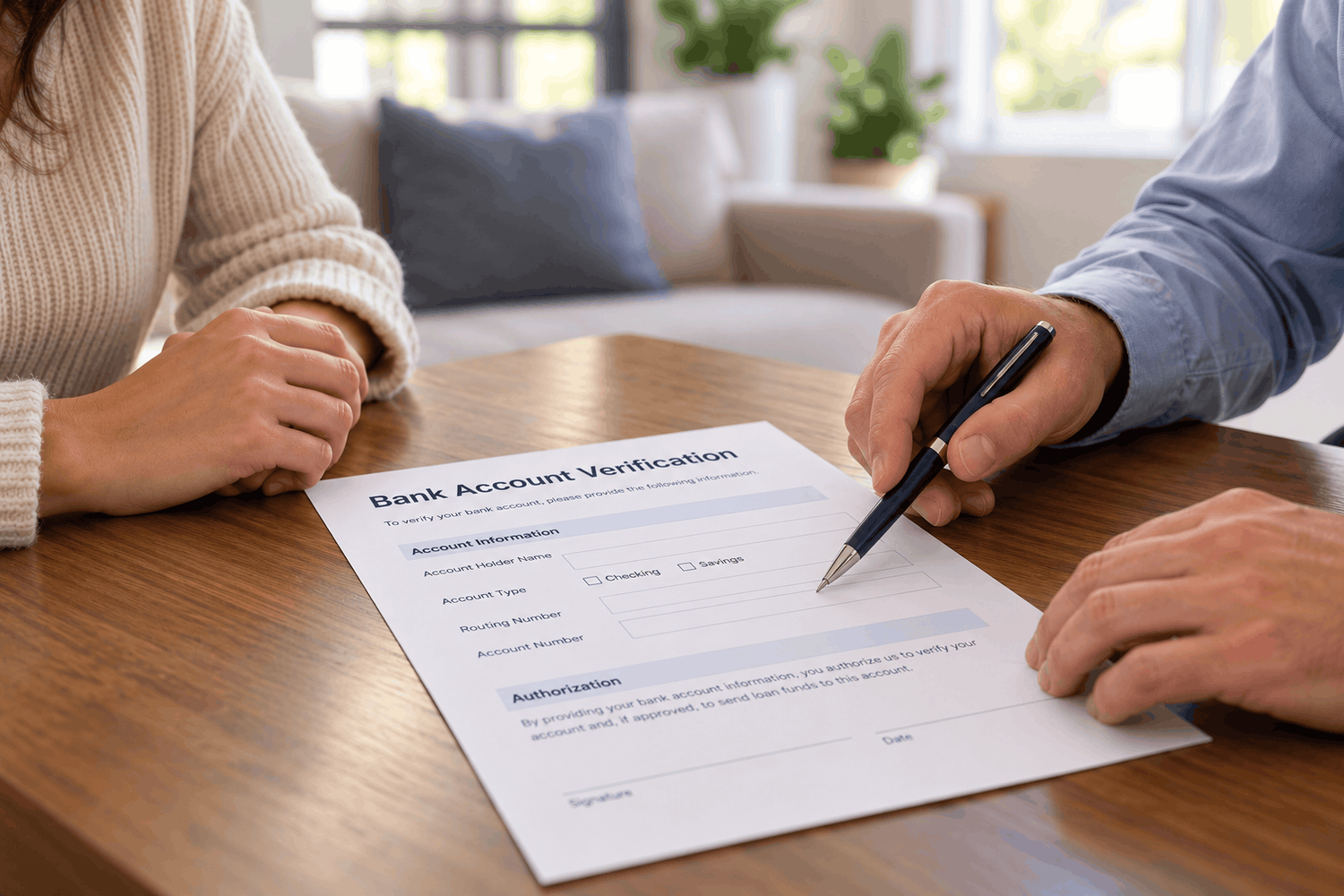
How Do Lenders Verify Your Bank Account for an Online Loan? Methods, Safety, and What to Expect
Written by: Jacob S.
Published on:


Somewhere in an online loan application, you will be asked about your bank account. That is not a formality. Your account is where a lender sends your funds and, in most cases, where your payments come from, so the lender needs to be sure the account is real, active, and yours.
Bank account verification for loans can happen in a few different ways. Some lenders use an instant verification service, while others ask for small test deposits or a recent bank statement. Knowing what to expect can help you prepare, protect your information, and avoid unnecessary delays.
This guide explains how lenders verify your bank account for an online loan, what each method involves, and what to do if verification does not go through.
Key Takeaways
- Verification protects you and the lender. It helps confirm that the account is active and belongs to you before funds are sent.
- There is more than one method. Lenders may use an instant bank verification service, small test deposits, or documents such as a bank statement.
- Verification methods take different amounts of time. Instant verification may take minutes, while test deposits and document reviews can take longer.
- Be careful with your login details. Only enter online banking credentials through a secure service after confirming the lender is legitimate.
- Incorrect information can cause problems. A wrong account number, routing number, or account holder name can delay verification.
- Bank verification is not a credit check. Confirming your account information does not automatically involve checking your credit report.
Why Do Lenders Verify Your Bank Account?
Lenders verify your bank account for three main reasons:
- To send your money to the right place. Loan funds are often deposited directly into your bank account, so the account details need to be correct.
- To confirm the account is yours. Verification helps make sure the banking information provided belongs to the applicant, which can help prevent fraud.
- To support the lending decision. Some lenders use banking information as part of a broader review of an applicant's financial circumstances and ability to repay.
Depending on the lender, banking information may be considered alongside income, employment, debt obligations, and credit history. Verification is only one part of the application process, and requirements can vary. Understanding the requirements for getting a loan can help you prepare the information a lender may request.
How Lenders Verify a Bank Account at a Glance
The method depends on the lender and your situation. Here are three common approaches.
| Method | How it works | What you do |
|---|---|---|
| Instant bank verification | You securely connect your account through an online verification service, which checks your banking information. | Choose your bank and complete the secure authentication steps when prompted. |
| Micro-deposits | The lender or verification provider sends one or more small test deposits, often under $1, and asks you to confirm them. | Check your account for the deposits, then enter the amounts or requested verification details. |
| Documents | You provide a recent bank statement or similar proof that the account belongs to you. | Upload clear, complete copies of the requested documents. |
Method 1: Instant Bank Verification
Instant bank verification is often the fastest option. Instead of waiting for deposits or sending paperwork, you securely connect to your bank through an online verification service. Depending on the service, it may confirm your account details, ownership, or other information you authorize it to access.
What to Expect
- A prompt asking you to choose your bank.
- A secure authentication window or redirect to your bank.
- A request to confirm which account to connect.
- A confirmation message once the connection or verification is complete.
Your bank may also ask for an additional security step, such as a code sent to your phone. Keep your phone nearby so you can finish in one sitting.
The process can take just a few moments, although not every financial institution supports the same verification services. If the connection does not work, the lender may offer another way to confirm your account.
Method 2: Micro-Deposits
With micro-deposit verification, a lender or verification provider sends one or more very small amounts to your account and asks you to confirm what you received.
Nacha's micro-entry guidelines describe small-dollar ACH transactions used to verify account information. These can include credits of less than $1 and offsetting debits. The transactions may include a description such as "ACCTVERIFY" to help identify their purpose.
Because deposits take time to post, this method can take longer than instant verification. Check your account activity for the small amounts, and follow the instructions provided to confirm them.
Be careful when entering the amounts. Incorrect entries may require you to repeat the process or contact the lender for help.
Method 3: Bank Statements and Other Documents
Some lenders ask for proof of your account, such as a recent bank statement, instead of or in addition to the other methods.
A clear, complete copy helps. The document may need to show your name, the financial institution, and enough account information to confirm ownership. Avoid blurry or cropped images, which can lead to a second request.
Requirements vary, so check what the lender needs before uploading anything. Some lenders may also ask for additional documentation if the name or account information does not match your application.
What Bank Account Information Do Lenders Check?
Whichever method is used, lenders generally want to confirm a few important details:
- Account ownership. The name on the account should match the applicant's information, although certain account arrangements may require additional review.
- Account and routing numbers. These details help identify the correct account and financial institution.
- Account status. The account may need to be active and able to receive electronic deposits.
- Account type. Some lenders require a checking account, while others may accept different types of accounts.
Some lenders may also review transaction activity when evaluating income or repayment capacity. However, confirming account ownership is not the same as verifying income. The information reviewed depends on the lender and the permissions you provide.
Because many online lenders rely on electronic deposits and payments, getting a loan without a bank account can be more difficult. The available options depend on the lender and how it handles funding and repayment.
Is It Safe to Share Your Bank Account Information?
Verification is a normal part of getting many online loans, and it can be done safely. Still, you should understand who is requesting your banking information and how it will be used.
The Consumer Financial Protection Bureau's guidance on sharing financial data highlights a few good habits whenever you connect an account to a financial service:
- Make sure you understand what information you are agreeing to share.
- Check whether the service can share your data with third parties.
- Find out what information the service stores and for how long.
- Review whether the service can make payments or move money between accounts.
- Know how to stop access later. Deleting an app or changing your password may not always end a service's access to your information.
Just as important, make sure the lender is legitimate before entering your banking details. Knowing how to verify a legitimate personal loan lender can help you recognize suspicious websites, misleading claims, and other warning signs.
Be especially cautious if someone asks you to pay a separate fee before receiving a promised loan. The Federal Trade Commission warns about advance-fee loan scams, where scammers demand money upfront while promising financing that may never arrive.
What to Do If Bank Verification Fails
If your account does not verify, the problem may be something simple. Here are a few common issues and what you can do about them:
- A typo in the account or routing number. Compare both numbers with your bank's official account information and correct any mistakes.
- A name mismatch. If the account holder's name differs from your application, the lender may need additional information.
- An account that is closed, new, or restricted. Some account conditions may interfere with verification or receiving deposits. If a restriction is involved, understanding how to go about removing a hold on your bank account may help.
- A security step that was not completed. Finish any authentication prompt or code request from your bank.
- Micro-deposits that have not posted yet. Give the deposits time to appear, then check your account again.
If you are still stuck, contact your lender through its official support channels. Ask whether there is another way to verify your account or whether additional information is needed.
Verification problems are one of several possible causes of online loan application delays. Missing documents, incorrect application details, and additional review requirements can also affect how quickly the process moves forward.
Does Bank Account Verification Affect Loan Approval or Funding?
Bank account verification can be an important part of the application process, but successful verification does not guarantee loan approval.
Lenders may still need to review your income, identity, credit information, and ability to repay. Completing verification helps confirm your banking details, but it does not replace the other steps in the lending decision.
Verification can also affect when funds are available. If your account information needs to be corrected or additional documents are requested, the lender may need more time to process your application.
Even after approval, deposits can depend on bank processing schedules and cutoff times. That is why fast loan approval and fast funding are not always the same thing. A quick decision does not necessarily mean the money will appear in your account immediately.
Bank Account Verification With Simple Fast Loans
Simple Fast Loans requires an active checking account where most of your income is deposited. In some cases, an online instant bank verification service is used to confirm that the banking information you provide belongs to you.
When you provide online banking credentials through the verification service to authorize access to information such as a bank statement, those credentials are provided securely and confidentially to the service.
Final approval depends on a completed and approved application, passing fraud verification, and verification of identification, employment, income, an active bank account, and debt obligations.
Simple Fast Loans offers online installment loans with fixed, scheduled payments. You can apply in about two minutes, and decisions may be available in minutes. Before accepting an offer, you can review your loan amount, monthly payment, and repayment schedule.
Related Frequently Asked Questions (FAQs)
Here are questions people often ask about verifying their bank accounts for online loans:
Why do lenders need to verify my bank account?
Lenders verify accounts to make sure the banking information is correct, confirm ownership, and help prevent fraud before sending loan funds.
How long does bank account verification take?
Instant bank verification can take just a few moments. Micro-deposits and document reviews may take longer because deposits need time to post and documents need to be reviewed.
Is it safe to enter my online banking login to verify an account?
It can be, when you use a legitimate, secure verification service. Confirm the lender is legitimate, understand what information is being shared, and review how to revoke access if needed.
Will bank account verification affect my credit score?
Bank account verification itself generally does not involve a credit inquiry. However, a lender may perform a separate soft or hard credit check during the application process.
What kind of bank account do I need for an online loan?
It depends on the lender. Many online lenders require an active checking account, while others may accept different account types.
Can I get a loan without a bank account?
Some borrowing options may be available without a traditional bank account, but many online lenders require one to deposit funds and collect payments.
What if my bank account is new?
Requirements vary by lender. A newly opened account may still qualify, but additional verification could be required. Contact the lender if you are unsure whether your account will be accepted.
